2026
HireWise — AI Job Search Assistant
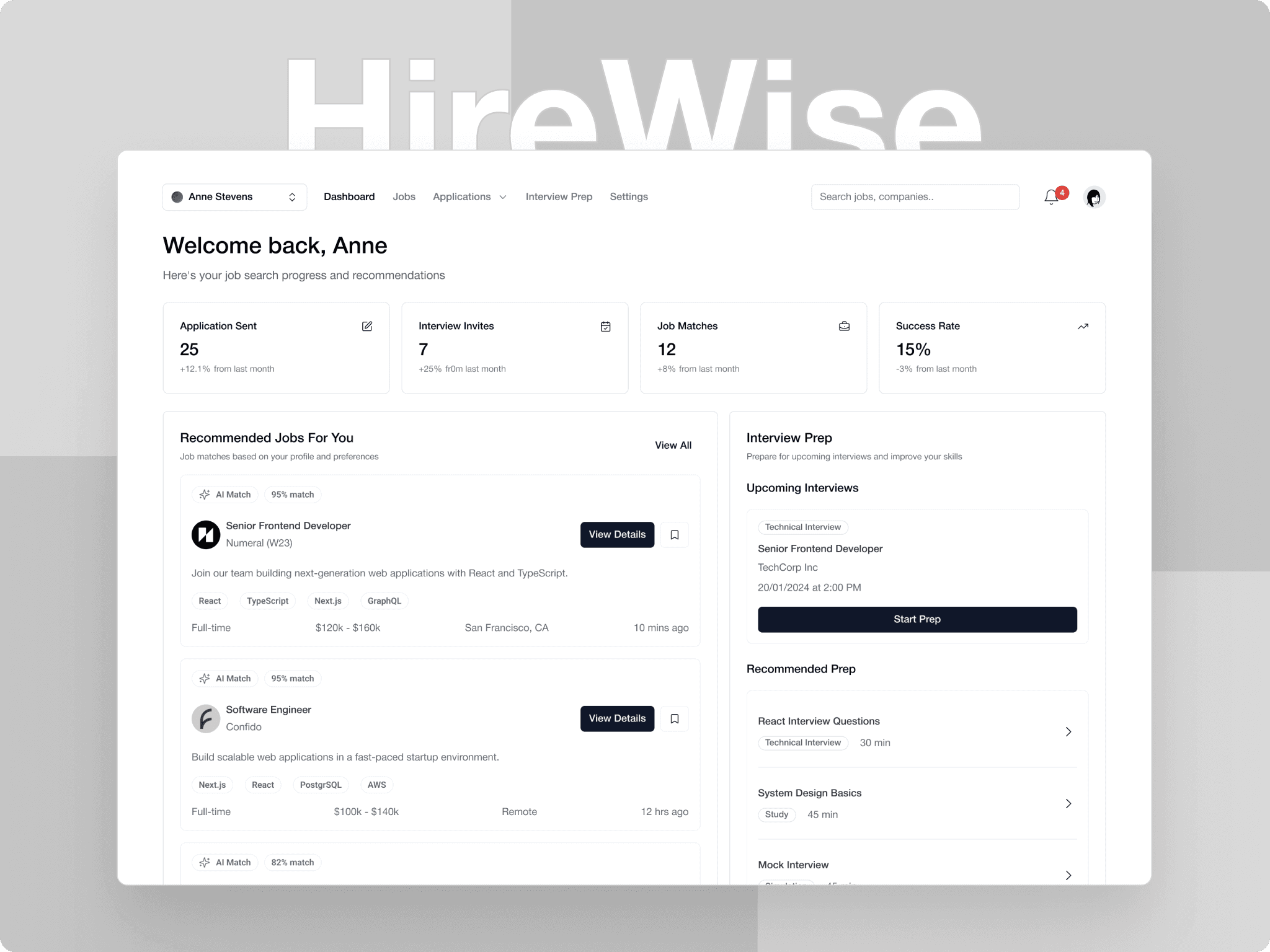
01 · Context and framing
Job searching has become a fragmented workflow spread across job boards, documents, spreadsheets, messaging platforms, and interview-preparation tools. Candidates spend significant time filtering irrelevant listings, rewriting similar applications, and tracking conversations manually—often without knowing whether their effort is improving their chances.
The emotional cost is equally important. Rejection without feedback, recruiter ghosting, misleading job descriptions, and fake postings make the process feel unsafe and demoralising.
The design challenge
Design a unified job-search experience that reduces repetitive work while helping candidates make safer, more informed decisions and improve through useful feedback.
02 · Research and discovery
The discovery phase combined secondary research, competitive analysis, and quote mining from job-seeking communities. Discussions across Reddit, LinkedIn, Glassdoor, and social platforms revealed recurring problems that conventional job boards address poorly.
Research methods
- Analysed discussions from job-seeking and recruitment communities.
- Compared LinkedIn, Indeed, Teal, Huntr, Jobscan, and Big Interview.
- Clustered repeated pain points through affinity mapping.
- Used Jobs-to-be-Done framing to distinguish functional needs from emotional needs.
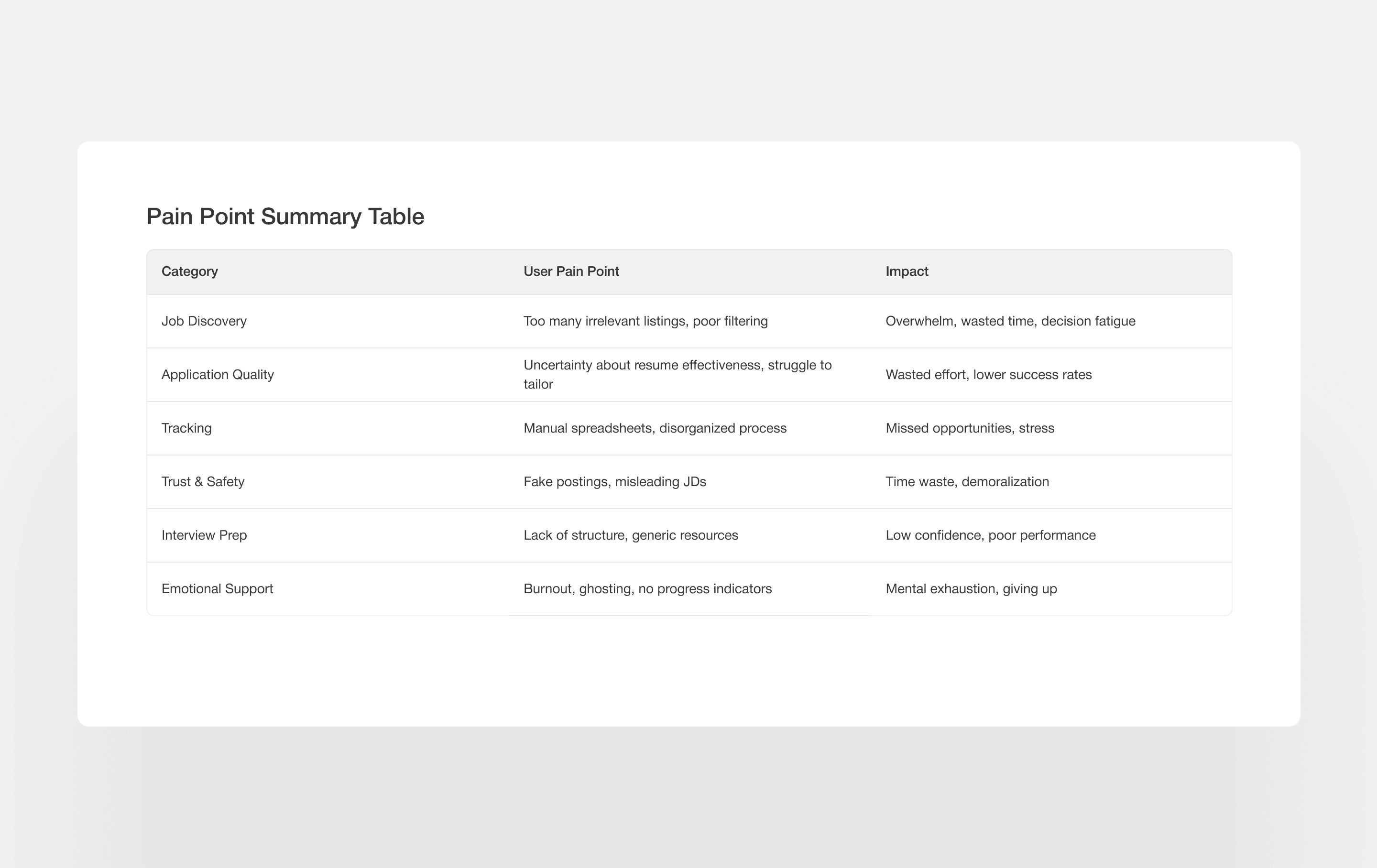
Five recurring patterns
- Information overload: Candidates spend more time filtering than applying.
- The tailoring paradox: Every application demands customisation, but candidates receive no validation that their changes are effective.
- The tracking gap: Spreadsheets and manual boards become unreliable as application volume grows.
- The trust crisis: Misleading requirements, suspicious employers, and exploitative test projects waste time and expose personal information.
- Emotional burnout: The absence of feedback makes progress difficult to recognise and rejection harder to process.
Core research insight
Productivity alone would not solve the problem. Candidates needed a product that combined efficiency with protection, transparency, and visible progress.
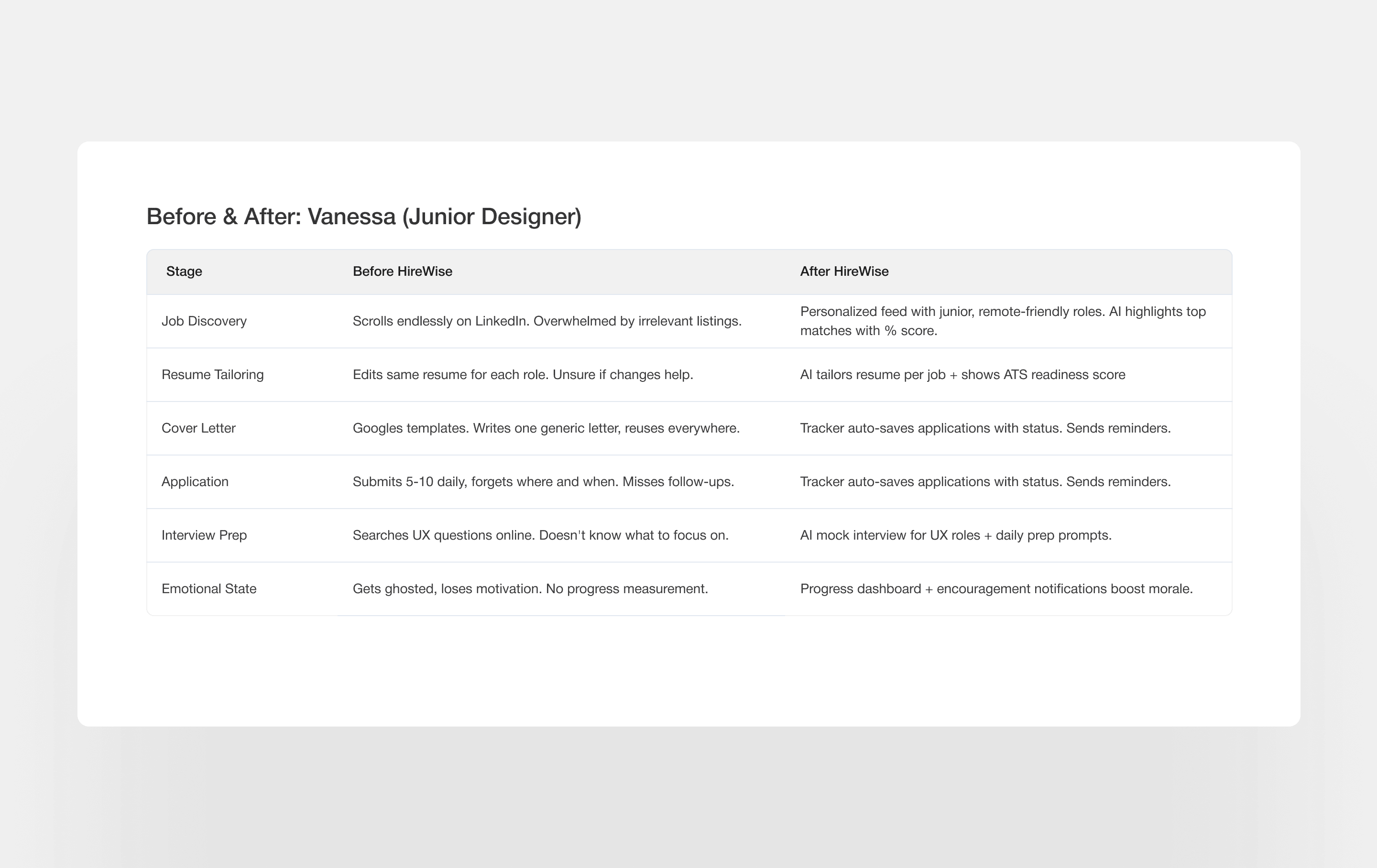
03 · Designing for different job-seeker realities
Three personas helped test whether the product model could support meaningfully different circumstances without becoming overly broad.
Vanessa · Early-career designer
A recent graduate pursuing her first remote product-design role. She needs help tailoring applications, understanding why she is being overlooked, and maintaining a consistent search process.
Daniel · Experienced career switcher
A backend engineer moving toward AI-focused roles. His challenge is translating existing experience into a new professional narrative and judging whether vague job descriptions genuinely match his skills.
Aisha · Freelancer moving into full-time work
A marketing strategist with strong project experience but limited conventional employment history. She needs to communicate transferable value, identify remote-friendly employers, and reduce the risk of automatic screening systems misreading her background.
Across all three journeys, the underlying need was the same: help candidates decide where to invest effort, present themselves clearly, and learn from each attempt.
04 · Product scope and prioritisation
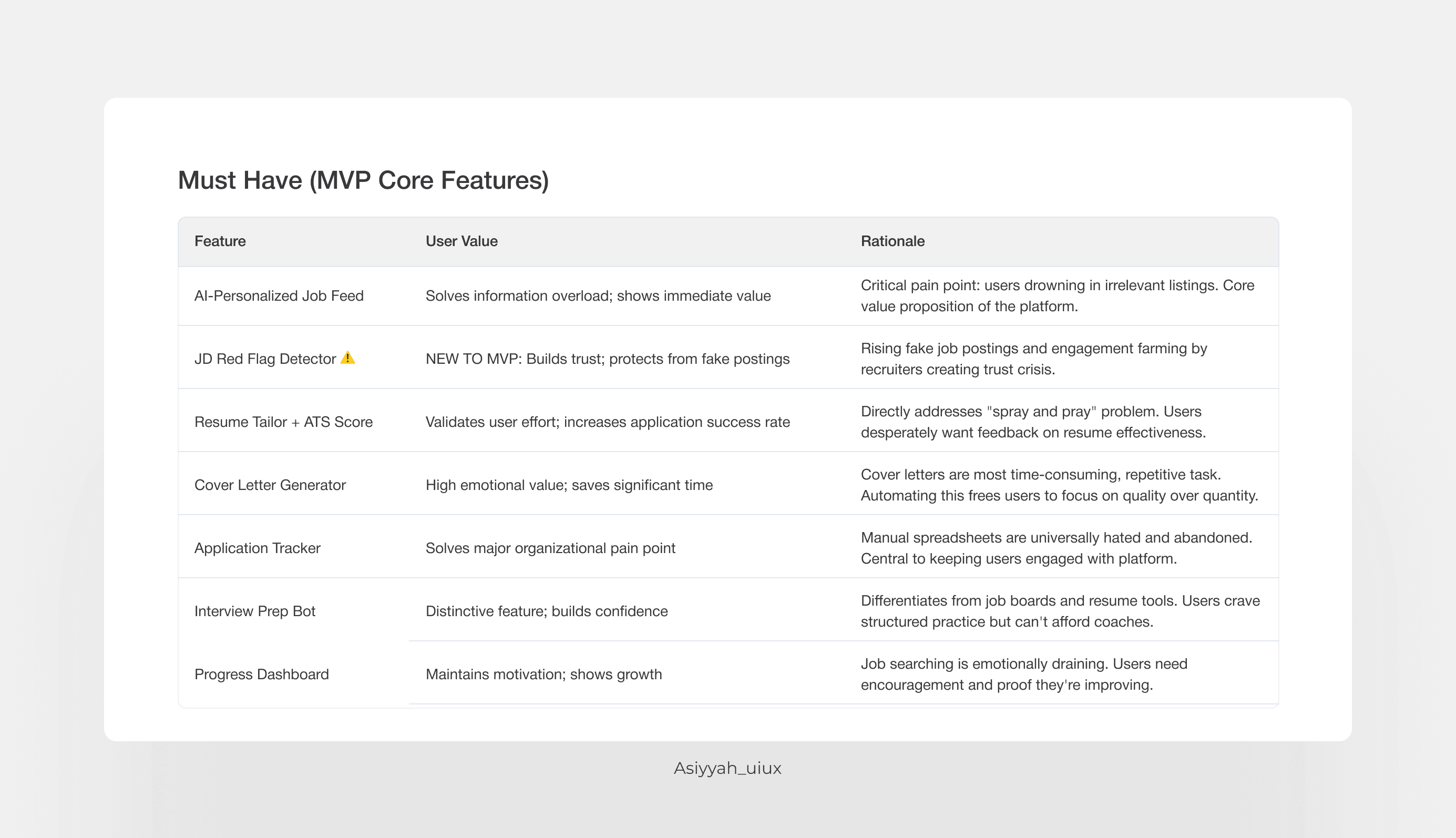
The feature set was prioritised using the MoSCoW method. The first release focused on the points where candidates lose the most time, confidence, or control.
Must have
- Personalised job discovery and fit signals
- Job-description credibility analysis
- Tailored application support
- Application tracking and reminders
- Role-specific interview preparation
- Structured interview feedback
Later phases
- Job-description summaries
- Email and LinkedIn import
- Encouragement and progress coaching
- Voice-based interview practice
- Community check-ins and success stories
Full recruiter chat, tax tools, and a complete applicant-tracking system remained outside the product’s purpose.
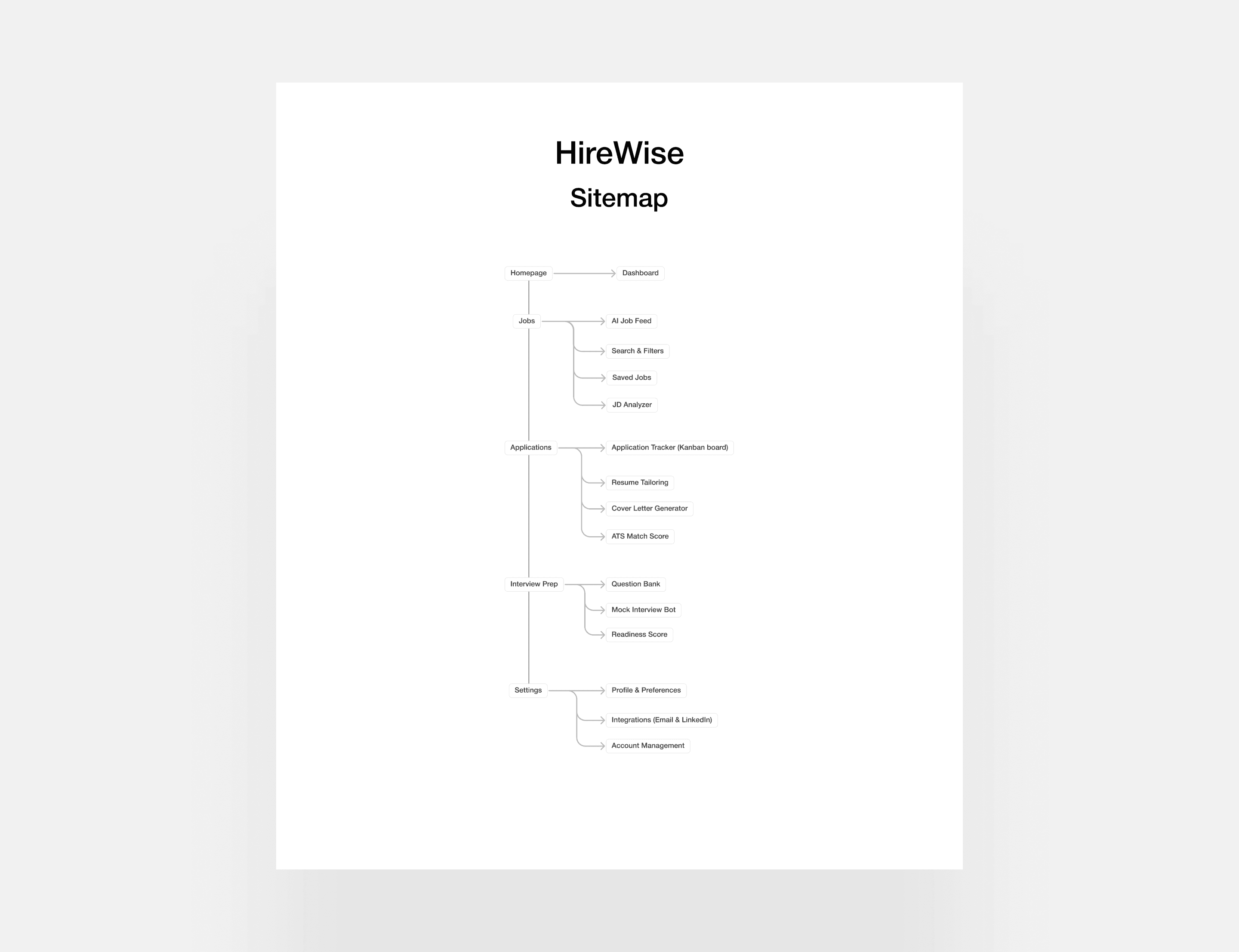
05 · Information architecture
The architecture follows the candidate’s journey instead of mirroring the structure of a traditional job board:
- Discover: Find relevant opportunities and understand fit.
- Evaluate: Review role quality, credibility, and potential red flags.
- Apply: Tailor application materials with transparent AI assistance.
- Track: Monitor every application, next step, and follow-up.
- Prepare: Practise role-specific interviews and review feedback.
This sequence keeps AI embedded within tasks rather than isolating it as a separate destination. The product explains recommendations at the moment they affect a decision.
06 · Product feature 01 — Red Flag Detector
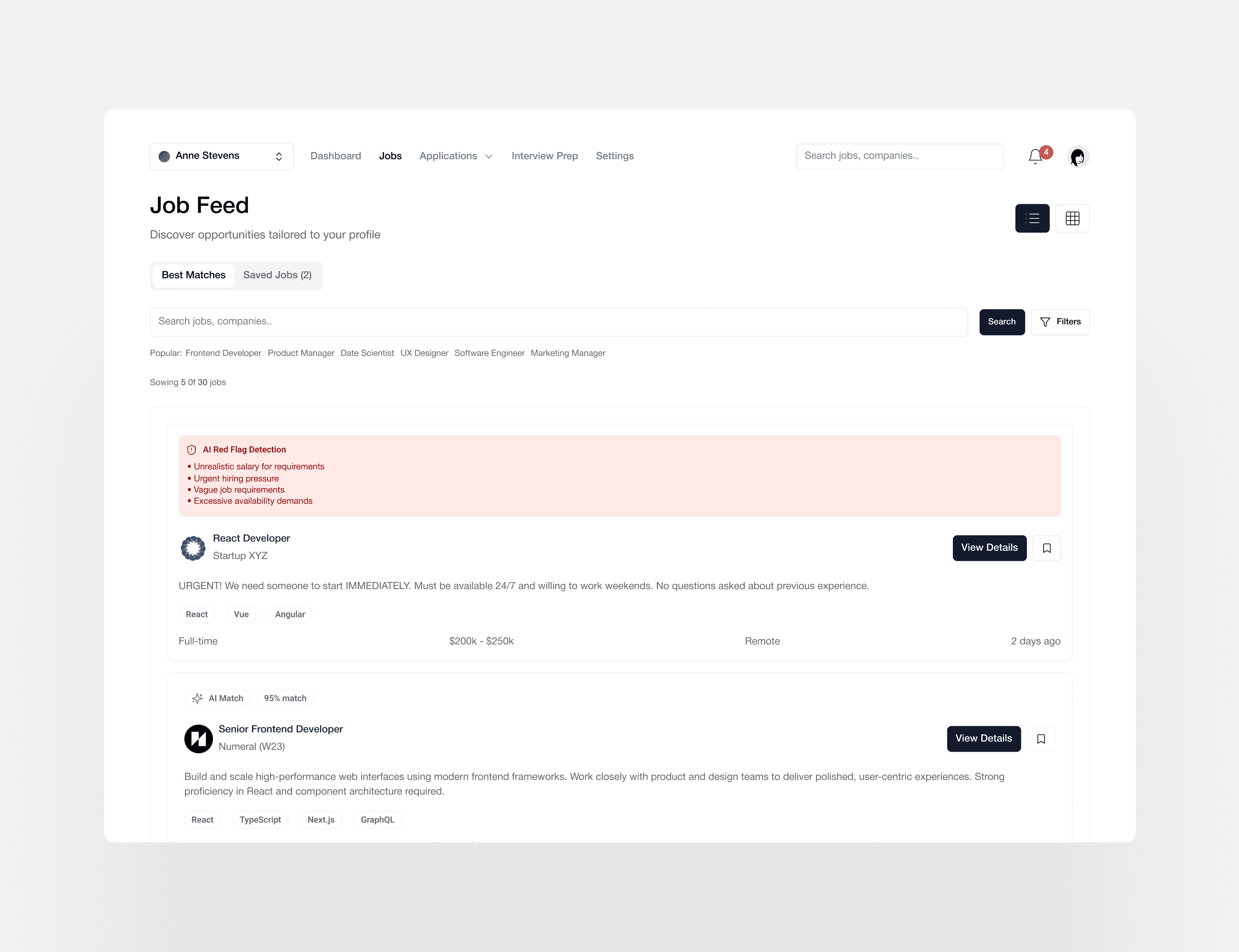
Fake postings and engagement-farming recruiters create a safety problem, not merely an inconvenience. HireWise analyses job descriptions before candidates invest time or disclose personal information.
The detector looks for signals such as:
- Compensation that conflicts with the required experience level
- Vague responsibilities or missing company information
- Unverified employers
- Requests for sensitive information too early
- Unpaid test projects with disproportionate scope
- Entry-level roles carrying unrealistic experience requirements
Warnings appear directly on job cards using verified, caution, and high-risk states. An expandable explanation shows why a role was flagged. Candidates retain control and may continue after acknowledging the warning.
Design principle
AI-generated warnings must be explainable. The interface surfaces evidence and preserves the candidate’s final decision instead of presenting an opaque verdict.
07 · Product feature 02 — AI-powered interview prep module
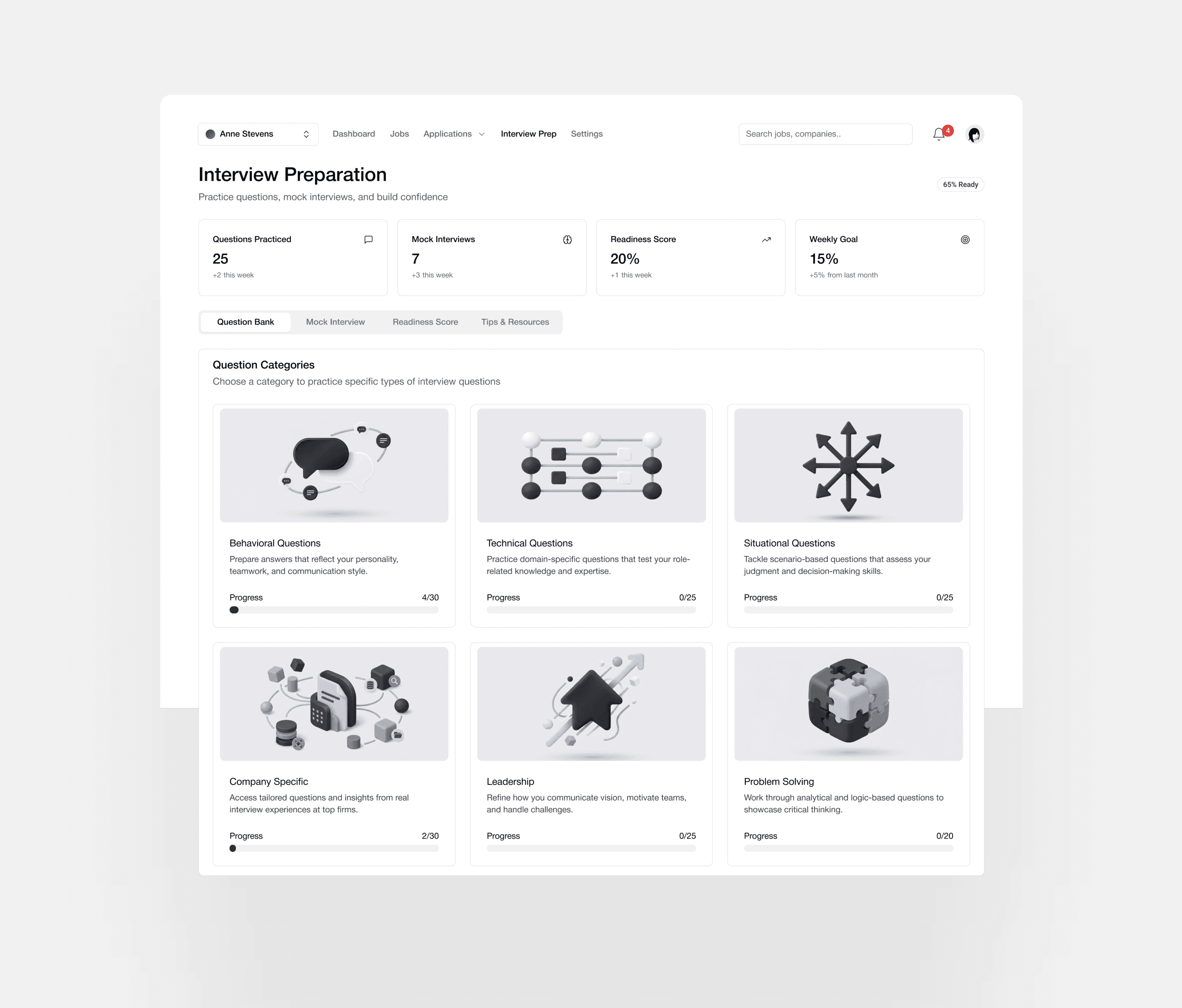
Generic interview lists rarely reflect a candidate’s actual role, seniority, or industry. HireWise creates a preparation space organised around the opportunity the candidate is pursuing.
Role-based question bank
Questions are grouped into behavioural, technical, case-study, and company-specific categories. Recommendations respond to job title, seniority, industry, and the requirements in the saved job description.
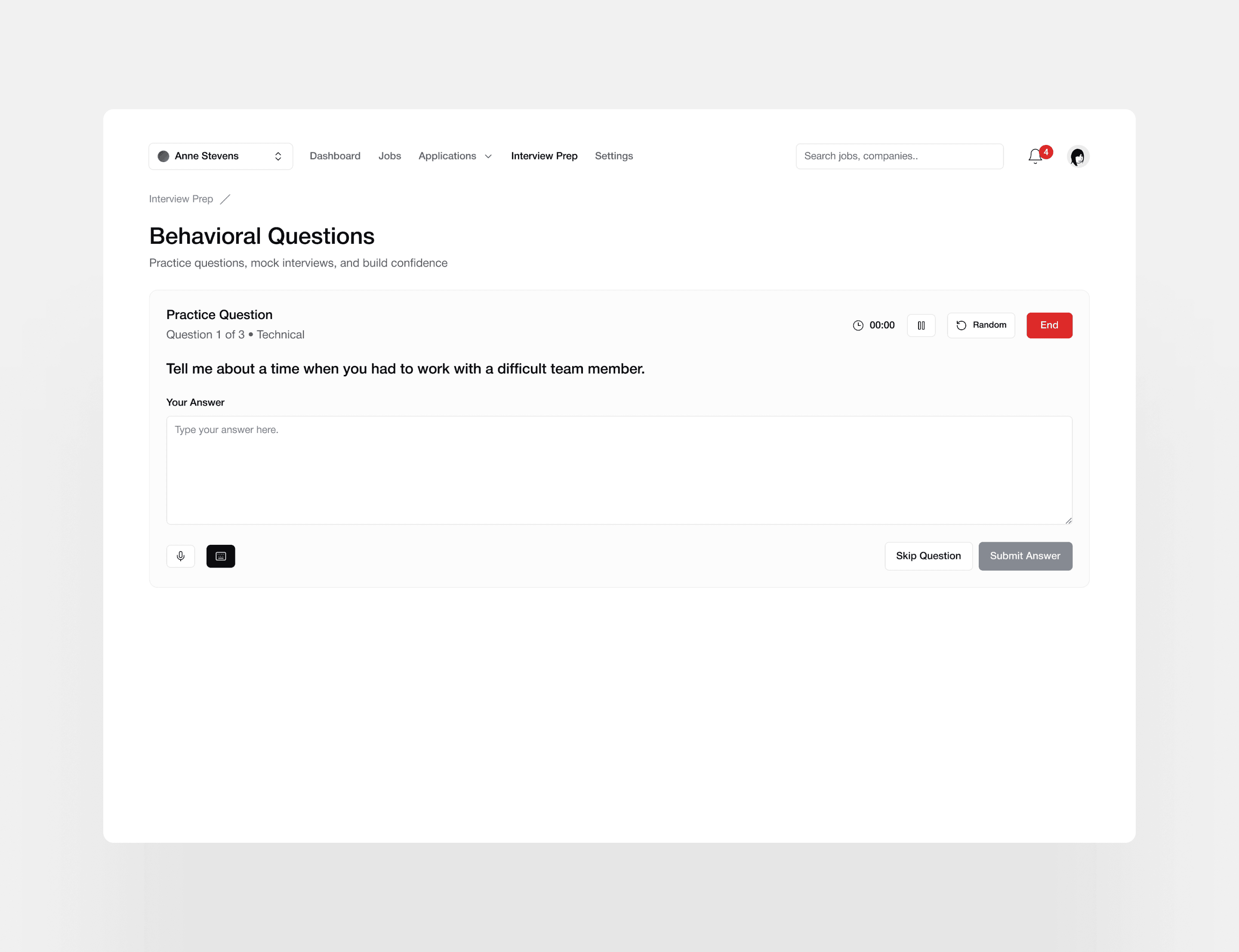
AI mock interview
The practice interface removes unrelated navigation and focuses attention on the current question. A timer introduces realistic pressure, while voice-to-text, pause, and resume controls support different practice styles.
08 · Product feature 03 — Interview feedback & skill reinforcement
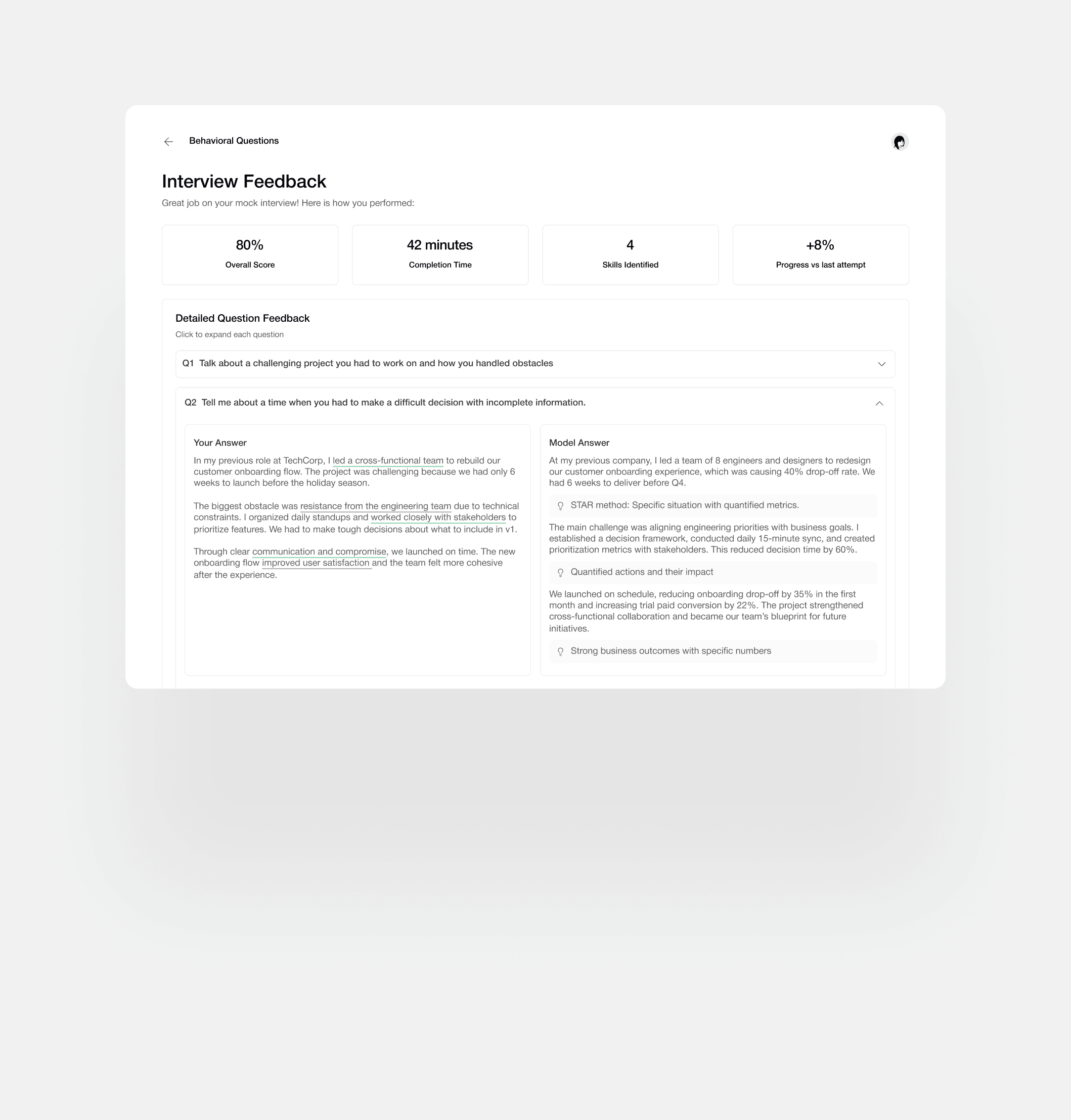
A score alone does not help candidates improve. The feedback experience converts each mock interview into a practical learning loop.
The result includes:
- An overall performance summary and improvement trend
- Question-by-question evaluation
- The candidate’s answer alongside specific suggestions
- A model response for comparison
- Skills demonstrated and skills requiring stronger evidence
- Clear next steps to practise again, review similar questions, or save notes
Strengths and improvement areas are visually separated, and the language remains growth-focused. Candidates can move between their answer and the model answer without losing context.
09 · Product feature 04 — AI-powered application tracker
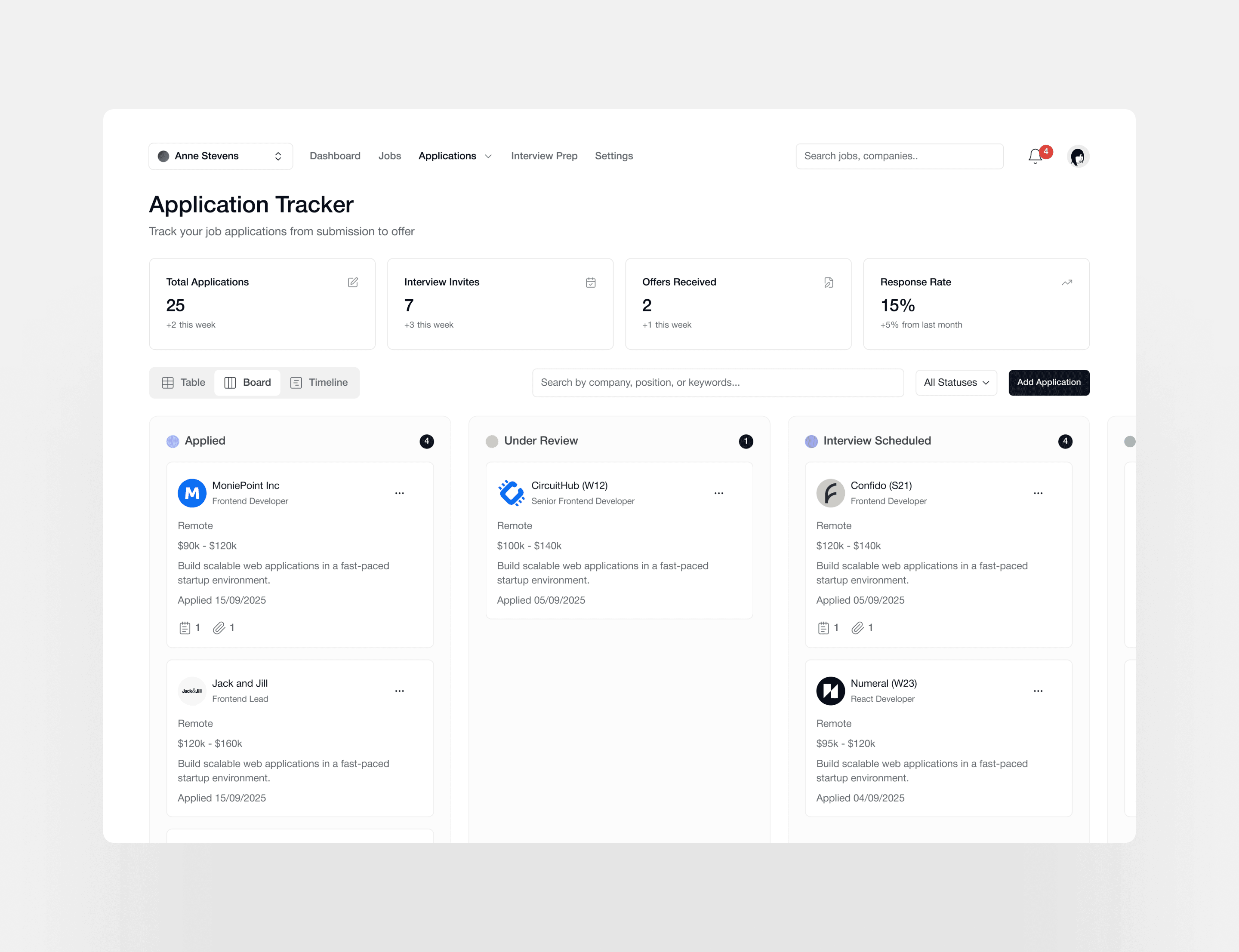
Manual trackers often fail because updating them becomes another task. HireWise brings discovery and tracking into one flow so applications can be recorded automatically.
Candidates can switch between timeline, kanban, and list views depending on whether they need chronology, pipeline visibility, or detailed comparison. Smart reminders surface applications that need follow-up, while notes, attachments, and interview details stay connected to each opportunity.
The tracker is designed to answer three questions quickly:
- Where is each application now?
- What needs attention next?
- Am I making measurable progress?
10 · Design system highlights
The interface needed to feel calm and dependable across dense job listings, high-attention interview sessions, safety warnings, and progress-tracking views. A compact design system established consistent visual rules before those experiences were assembled.
Visual foundations
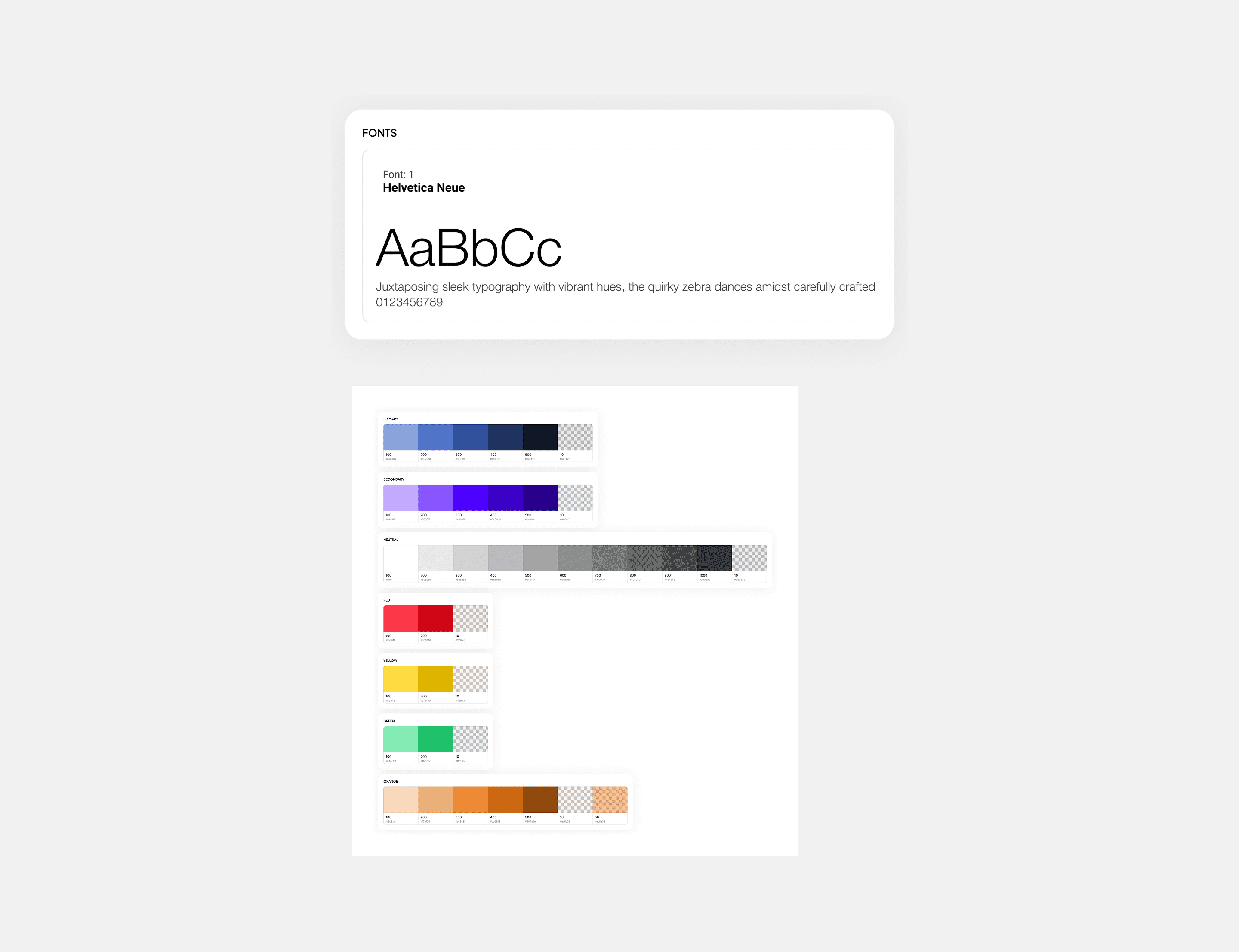
Helvetica Neue provides a neutral, highly legible typographic foundation, with a defined hierarchy covering display headings, section titles, body copy, labels, and compact metadata. The colour system pairs deep navy and blue with a secondary violet scale, while semantic red, yellow, green, and orange tokens communicate risk, caution, success, and progress consistently.
Reusable components
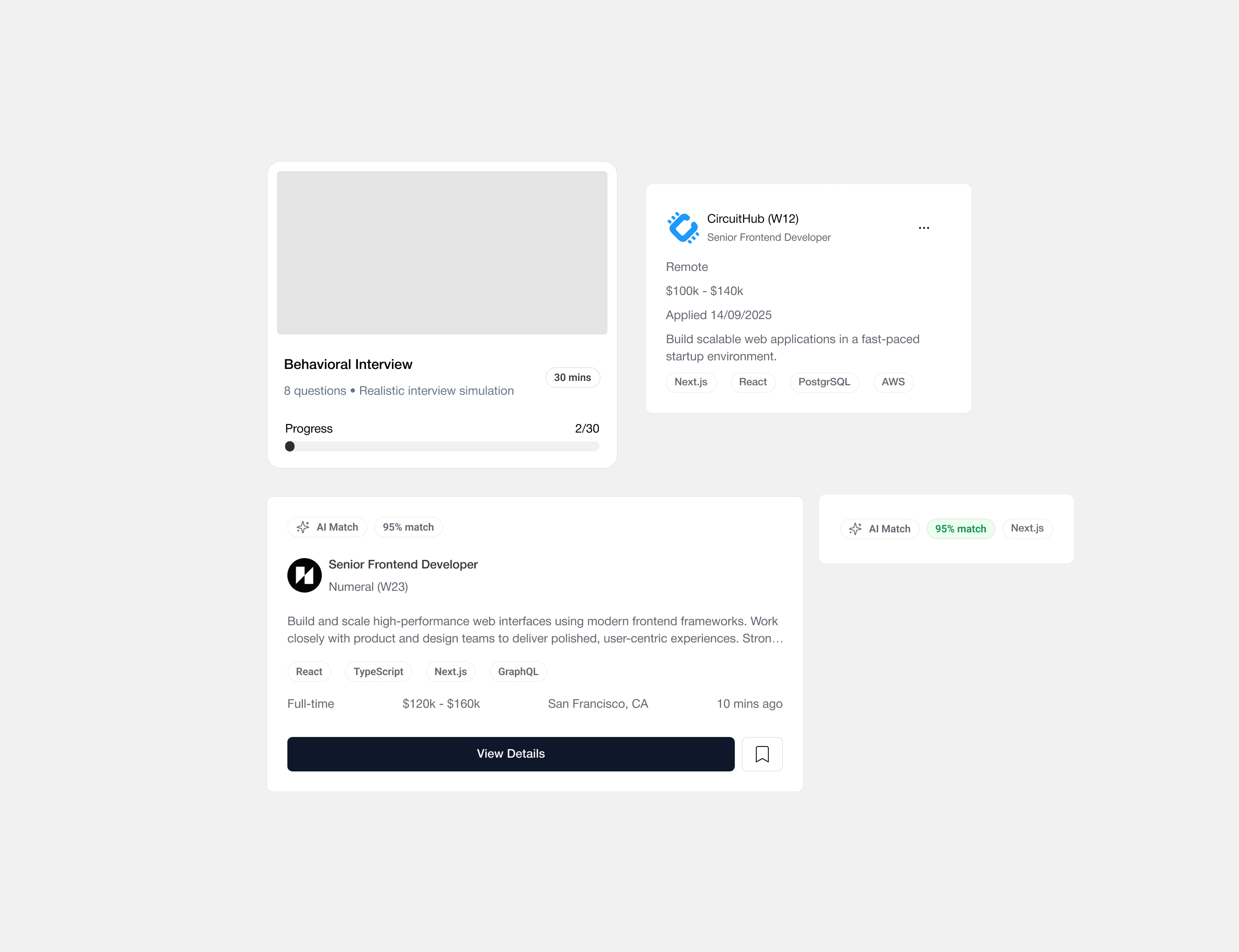
The component library standardises recurring patterns such as job cards, interview-session cards, match indicators, skill tags, progress states, actions, and saved-item controls. Variants were designed to accommodate different information densities without changing the underlying interaction model.
This system made the four core product features feel connected: the same status language, spacing logic, border treatment, and interaction patterns carry from job evaluation through interview preparation and application tracking.
11 · Key learnings
Safety can create trust faster than convenience
The original direction emphasised tailoring and tracking. Research showed that protecting candidates from exploitative or misleading listings was equally valuable and more differentiating.
Emotional design is functional design
Job search products operate in a context of rejection and uncertainty. Progress states, feedback language, reminders, and errors must acknowledge that emotional reality.
Fragmentation is the real competitor
Candidates did not need another isolated tool. The stronger proposition was reducing the number of disconnected systems required to discover, apply, track, and prepare.
AI should augment agency
Candidates valued recommendations, explanations, and coaching—but still wanted final control. Transparency became a product requirement rather than an optional detail.
12 · Reflection
HireWise reframes job searching as a guided and protected experience rather than an application-volume contest. Its value comes from connecting functional support—discovery, tailoring, tracking, and preparation—with the confidence candidates need to continue.
The concept demonstrates how AI can make a complex workflow more humane when it explains its reasoning, reinforces learning, and leaves consequential decisions with the person using it.